Exam Preparation Guide: Master Any Exam.
Everything you need to know about preparing for and succeeding in any exam — from study strategies that actually work to managing stress on exam day.
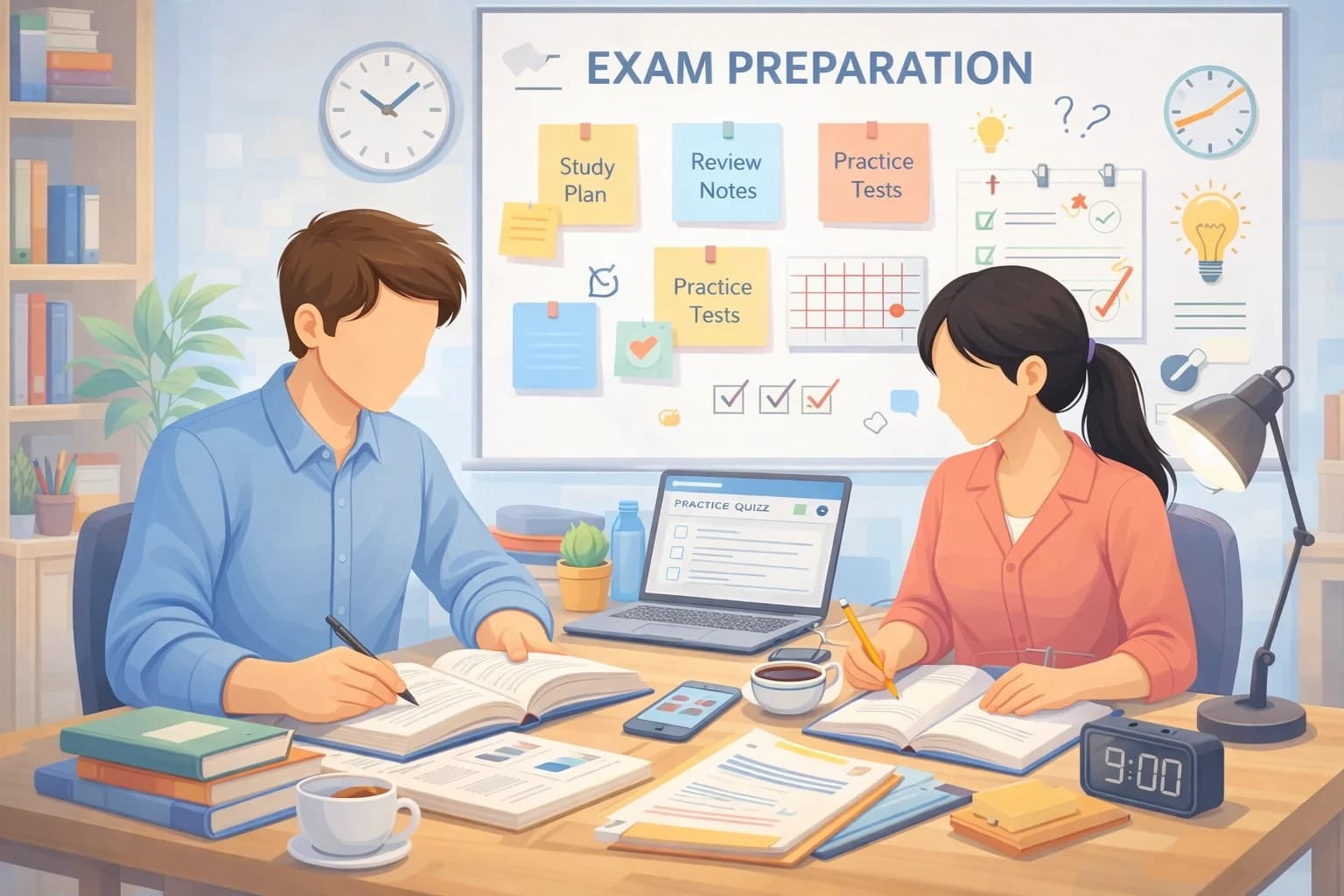
Introduction
Exams stress people out. Whether you're a student preparing for school exams, working toward a professional certification, or taking any kind of test, that pre-exam anxiety is real. But here's the truth: most exam stress is preventable. With the right strategies and mindset, you can prepare effectively and walk into your exam feeling confident.
This guide covers everything you need to know about preparing for any exam - from study strategies that actually work to managing stress on exam day. The techniques here apply whether you're taking a high school test, college finals, professional certifications, or entrance exams. The core principles are the same.
What Actually Happens During an Exam
Let's start with the basics. An exam is a test designed to measure how much you've learned about a subject. But it's not just about memorizing facts - it's about understanding, applying, and sometimes creating new insights from what you've learned.
Exams come in many formats. Some use multiple choice questions where you recognize the right answer. Others require you to write essays or solve problems from scratch. Some test pure memorization, others test critical thinking. The format depends on what the exam is trying to measure.
Here's something important: your exam performance depends mostly on how you studied beforehand, not on how you perform under pressure on exam day. Yes, exam day matters, but good preparation makes exam day less stressful and much more likely to go well.
The real purpose of an exam isn't to trick you or make you feel bad. It's to see whether you actually understand the material well enough to apply it. If you prepare with this in mind - not just memorizing but actually learning - you'll do better than someone who memorizes without understanding.
Why Exams Make People Anxious
Let's be honest: exams are stressful. You've studied for weeks or months, there's time pressure, and your performance gets a grade or score that might affect your future. Your brain perceives all this as a threat, which triggers your stress response. Your heart races, your palms sweat, your mind might go blank.
Some anxiety is actually helpful. It keeps you alert and motivated. But too much anxiety can backfire - it makes you panic, forget things you actually know, and perform worse. This is called test anxiety, and it's extremely common. The good news is you can manage it.
Why do people feel exam anxiety?
- Fear of failure - Worry that you won't pass or won't get a good enough grade
- Feeling unprepared - Not knowing the material well enough
- Past bad experiences - Previous exams that went poorly
- Perfectionism - Needing to get a perfect score
- Not knowing how to study - Feeling lost about how to prepare effectively
Understanding what causes your anxiety helps you address it directly. If it's fear of failure, you need perspective on what failure actually means. If it's feeling unprepared, you need better study strategies. If it's past experiences, you need to rebuild confidence. Different causes need different solutions.
Types of Exams You Might Face
Different exam formats test different skills and require different preparation strategies. Let's look at the main types:
Multiple Choice Exams
You read a question and choose from several options. Seems straightforward, but here's the trick: sometimes multiple answers seem correct. You need deep understanding to pick the best one. Multiple choice exams reward recognition - you don't have to recall information from scratch, just recognize the right answer when you see it.
Preparation strategy: Focus on understanding concepts deeply, not just memorizing facts. Practice tests are essential because you need to identify which answer is most correct, not just which answers you recognize.
Essay or Short Answer Exams
You write your own answers, explaining concepts in your own words. These test deeper understanding because you can't just recognize an answer - you have to actually know it well enough to explain it clearly.
Preparation strategy: Practice writing essays and practice explaining concepts out loud. Know what key points you need to include. Practice organizing your thoughts quickly.
Problem-Solving Exams
Math, physics, programming, and technical exams where you solve problems step-by-step. You need to understand the underlying concepts and know how to apply them to new situations. One mistake early can mess up your entire solution.
Preparation strategy: Work through tons of practice problems. Understand not just the steps, but why each step is necessary. Learn from mistakes and understand where you went wrong.
Oral Exams
You sit across from an examiner who asks you questions verbally. You have to think on your feet and explain your answers clearly. More intimidating than written exams because it's one-on-one, but you can also ask for clarification if you're confused.
Preparation strategy: Practice explaining concepts out loud. Do mock interviews with friends or teachers. Be comfortable with pausing to think before answering.
Mixed Format Exams
A combination of multiple choice, short answer, and essays. You need to be prepared for everything. This is common in school and college exams. The challenge is balancing your time across different question types.
Preparation strategy: Practice with all formats. Develop time management skills. Know your weak areas and focus on those.
Open-Book vs Closed-Book
Open-book exams let you use notes or textbooks during the test. Don't be fooled into thinking this means you don't need to study. You still need to know the material well enough to find answers quickly and know how to use what you find.
Closed-book exams require you to have memorized the material. You can't look anything up, so rote memorization and active recall are essential.
Study Strategies That Actually Work
How you study matters way more than how long you study. You could study for 10 hours ineffectively and learn less than someone who studies 2 hours using good strategies. Here's what actually sticks in your brain:
Active Learning, Not Passive Reading
Sitting and reading your textbook is one of the least effective ways to study. Your brain doesn't engage, you get bored, you don't remember what you read.
Instead, actively engage with the material:
- Write summaries in your own words instead of copying
- Make flashcards and quiz yourself
- Teach the concept to someone else (or even to a stuffed animal)
- Create diagrams, mind maps, or visual representations
- Do practice problems
- Write essay answers
When you have to think about the material and articulate it, you remember it better. This is why explaining something to someone else is so effective - you can't just pretend to understand, you have to actually know it.
Use Spaced Repetition
Your brain remembers things better when you review them multiple times over days and weeks, not all at once. If you cram the night before, you might pass the exam, but you'll forget most of it within days.
Spaced repetition works like this:
- Study material on day 1
- Review it again on day 3
- Review again on day 7
- Review again on day 14
- Continue reviewing at increasing intervals
Each time you review, the material stays in your memory longer. Apps like Anki automate this by showing you flashcards at optimal review intervals based on your performance. This beats cramming every time because it builds long-term memory, not just short-term recall.
Take Practice Tests
The single best predictor of exam success is taking practice tests. Here's why:
- They show you what you don't know
- They get you used to the exam format and time pressure
- They build confidence
- They reduce anxiety (because the real exam feels less scary after practice tests)
How to take practice tests:
- Use real exam conditions: same time limit, no cheating, quiet environment
- Treat them like real exams - get used to that pressure
- When you get questions wrong, review why. Don't just look at the answer - understand the concept you missed
- Track which topics you struggle with
The more practice tests you take, the better you'll do. Most people who score well on exams took many practice tests beforehand.
Focus on Your Weak Areas
After practice tests, identify which topics you struggle with. Then drill those topics specifically. Don't waste study time reviewing stuff you already know well. Use your time efficiently by targeting weaknesses.
This is where you'll see the most improvement. The 80/20 rule applies: 20% of your topics probably account for 80% of your mistakes. Focus there.
Make Good Notes
Taking notes by hand (not typing) forces you to process information and helps you remember better than just reading or typing. But don't write down everything word-for-word - that's not effective.
Good note-taking:
- Summarize in your own words
- Use abbreviations
- Highlight only the most important parts
- Organize logically
- Add examples or questions
Your notes should be concise and organized - they should be study material, not transcripts of lectures.
Use Multiple Study Methods
Different subjects need different approaches. Mix things up so your brain stays engaged and you learn material from multiple angles:
- For memorization: Flashcards, spaced repetition, mnemonics
- For concepts: Mind maps, diagrams, teaching others
- For problem-solving: Lots of practice problems, solving variations
- For essays: Write practice essays, get feedback, review model answers
- For practical skills: Hands-on practice, tutorials, labs
Creating an Exam Study Schedule
Good planning prevents last-minute panic. Here's how to organize your study time:
Start Early, Study Consistently
If you have a month until the exam, study a little every day rather than cramming. Consistent studying beats marathon cramming. Your brain needs time to process and remember information. A good rule of thumb: If your exam is 4 weeks away, plan to study 1-2 weeks before. If it's 8 weeks away, plan to start studying 4-6 weeks before. Always leave buffer time.
Break Material Into Chunks
Don't try to study everything at once. Divide the material into manageable topics - maybe 5-10 topics total. Study one topic at a time, get good at it, then move on. This prevents overwhelm and gives you a sense of progress.
For each topic: Learn the basics, deepen understanding with examples, practice problems or questions, review and solidify. Once you've done all topics once, go back and review the topics where you struggled most.
Study When Your Brain is Fresh
Some people study best in the morning when they're alert. Others are night owls and focus better at 9 PM. Know your peak hours and use them for the hardest or most important material. Save easier review for times when your energy is lower. Don't waste your peak mental hours on easy review. Use them for tough material.
Take Regular Breaks
Study for 25-50 minutes, then take a 5-10 minute break. This is based on how long your brain can focus intensely. After about 45-50 minutes, your concentration drops.
During breaks:
- Get water or a healthy snack
- Move around, don't stay at your desk
- Look away from screens
- Do something completely different
Don't study for 4 hours straight - your brain stops absorbing information after a while.
Create a Written Study Schedule
Write down exactly what topics you'll study each day. This removes the decision-making and keeps you accountable. It also prevents you from accidentally skipping important material.
Example:
- Monday: Chapter 1-2 + practice problems
- Tuesday: Chapter 3 + review Chapter 1-2
- Wednesday: Chapter 4 + take practice test on Chapters 1-4
- And so on...
A written schedule helps you see progress and stay on track.
Effective Note-Taking Techniques
Your notes become your study material, so taking effective notes is crucial. Here are some proven methods:
The Cornell Method
Divide your page into three sections:
- Right column (notes): Write notes during lectures or while reading
- Left column (questions/keywords): Write questions that your notes answer, or key terms
- Bottom (summary): Write a 2-3 sentence summary after class
This forces you to organize information and makes reviewing easier.
Mind Maps
Draw a central idea in the middle and branch out with related concepts. Show connections between ideas. Good for visual learners and helps you see how topics connect. Use colors to make it even better.
Outline Format
Use numbers and letters to show hierarchy:
- 1. Main topic
- A. Subtopic
- B. Subtopic
- i. Detail
- ii. Detail
- 2. Next main topic
This makes material organized and easy to scan when reviewing.
Write in Your Own Words
Don't copy word-for-word from the textbook or lecture. Rewrite concepts in language you understand. This forces you to actually process the information, not just copy it.
Highlight Strategically
Don't highlight every other line - that's useless for studying. Highlight only the most important words and phrases. If you're highlighting too much (more than 20% of the text), you're not being selective enough.
Managing Exam Stress and Anxiety
Even well-prepared students feel nervous before exams. Here's how to manage the stress:
Sleep is Your Secret Weapon
Get good sleep the week before the exam, especially the night before. Sleep helps your brain consolidate memories - meaning it transfers information from short-term to long-term memory. Sleep also makes you think more clearly.
Staying up late cramming is terrible because:
- You'll be exhausted and can't think clearly
- Your stressed brain can't process information effectively
- You'll forget most of it anyway if you don't sleep
Get 7-9 hours of sleep, especially the night before the exam.
Exercise Helps Anxiety
Physical activity reduces stress hormones and clears your mind. Go for a walk, do some yoga, play a sport, do push-ups - anything to move your body. Even 20-30 minutes of exercise can calm your nerves. This works physiologically - exercise burns off stress hormones and releases endorphins that improve mood.
Breathing Techniques Work
When you feel anxious, your breathing gets shallow and quick. Consciously slow it down. Try the 4-4-4 method:
- Breathe in through your nose for 4 counts
- Hold for 4 counts
- Breathe out through your mouth for 4 counts
- Repeat 5-10 times
This actually activates your parasympathetic nervous system, which calms your body down. It works.
Eat and Drink Properly
Don't skip meals before an exam. Low blood sugar makes anxiety worse and makes your brain work poorly. Eat something substantial but not too heavy - you want energy, not to feel full.
Eat breakfast on exam day. A good meal with protein and carbs helps stabilize blood sugar and mood. Stay hydrated - even mild dehydration makes anxiety worse.
Positive Self-Talk Matters
Your thoughts affect your performance. Instead of thinking "I'm going to fail" or "I don't know anything," tell yourself:
- "I've studied hard and I'm prepared"
- "I can handle this"
- "I know more than I think I do"
- "Whatever happens, I'll be okay"
This isn't about being unrealistic. Be honest about your preparation. But be encouraging to yourself. Your inner dialogue matters.
Perspective Helps
Remind yourself that one exam isn't everything. Yes, the exam is important, but it's not the end of the world if you don't get a perfect score. You can handle whatever happens. You've studied, you're prepared, and you're going to do your best. That's all you can do. This perspective takes the pressure off and actually helps you perform better. When you're not panicking, you can think clearly.
Exam Day Strategy and Tips
What you do on exam day matters. Here's how to approach it:
Arrive Early
Get to the exam location 10-15 minutes early. This gives you time to:
- Settle down and calm yourself
- Find your seat and get comfortable
- Mentally prepare
- Use the restroom if needed
Rushing in late will stress you out. Build in buffer time.
Read All Instructions Carefully
Before you start answering questions, read the entire exam and all instructions carefully. Some questions might have special directions. Sometimes instructions tell you to answer only certain questions or explain your reasoning. Missing these details can cost you points.
Do a Quick Preview
Spend the first 2-3 minutes quickly scanning all questions. Look at:
- How many questions there are
- Which ones look easy vs hard
- How many marks each question is worth
This helps you mentally prepare and plan your time. You'll know what's coming.
Manage Your Time
Don't spend 20 minutes on one question if the exam is only an hour. Calculate how much time you have per question.
Time management strategy:
- Do easier questions first to build confidence
- Tackle medium difficulty questions
- Leave hardest questions for last
- If you get stuck on a question, move on and come back to it
If a question would take 5 minutes normally but you've already spent 10 minutes, skip it and come back if there's time.
Don't Second-Guess Yourself Constantly
Your first instinct is usually right, especially if you've studied well. If you read a question and immediately think an answer, that's probably correct. Constantly changing answers usually makes things worse because you second-guess yourself.
Rule: Only change an answer if you're certain you were wrong, not just unsure.
Show Your Work on Problem-Solving Exams
Even if you get the final answer wrong, you might get partial credit for showing your thinking. Graders can see your work and give you credit for the steps you got right. Plus, writing it out helps you catch mistakes.
Check Your Work If You Have Time
At the end, review your answers if time permits. Look for:
- Silly mistakes (like wrong arithmetic)
- Incomplete answers (questions you forgot about)
- Questions where you meant to write more
But don't obsess. You've done what you can. At some point, you have to submit and trust your preparation.
Common Exam Mistakes to Avoid
Learn from mistakes others make so you don't repeat them:
- Cramming — Studying everything the night before doesn't work. Your brain can't process that much information. You'll feel stressed, sleep poorly, and forget most of it after the exam anyway. Consistent studying over weeks beats one night of cramming.
- Only Passive Reading — Reading your textbook without engaging is ineffective. You need to actively work with the material - make notes, do problems, explain concepts, make flashcards.
- Not Taking Practice Tests — Practice tests are the best way to prepare. They show you what you don't know and get you used to the exam format. People who skip practice tests usually do worse than those who take them.
- Ignoring Weak Areas — It's easy to focus on topics you already understand. They're less frustrating. But your score improvement comes from fixing weak areas. Be honest about what you don't know and target it.
- Comparing Yourself to Others — "Oh, they only studied for 2 hours and did great." Everyone's different. Some people learn faster, some had better background knowledge, some are just naturally better at exams. Focus on your own preparation, not what others are doing.
- Studying in Distracting Environments — You can't focus if you're on social media, watching Netflix, or around loud noises. Find a quiet place and eliminate distractions. Turn off your phone notifications. Your environment matters more than you think.
- Not Reviewing Mistakes — Your past wrong answers are your best study material. They show exactly what you need to work on. Review them thoroughly. Don't just look at the right answer - understand why you got it wrong.
After the Exam - What to Do Next
The exam is over, but your learning doesn't have to stop there:
Review Your Mistakes
Once you get your exam back, review your mistakes. Don't just look at your score - understand why you got questions wrong. This is crucial.
- What concept didn't you understand?
- Did you misread the question?
- Did you make a careless mistake?
- Did you run out of time?
Understanding the root cause helps you prevent similar mistakes next time.
Analyze What Went Wrong (or Right)
If you didn't score as well as you wanted:
- Was it lack of understanding of material?
- Was it your study strategy (you studied but didn't learn)?
- Was it test anxiety?
- Was it time management during the exam?
- Did you not study enough?
Identifying the real problem helps you fix it next time.
If you did well, that's awesome. But still review what worked and keep doing what worked.
Give Yourself Credit
Remember that one exam doesn't define you. You get better with practice and experience. Your first exam might not go great, but as you do more exams and refine your study strategies, you'll improve. Give yourself credit for trying and learning.
Final Thoughts
Exam preparation is a skill you can get better at. Your first exams might feel overwhelming, but as you practice good study habits and learn what works for you, it gets easier. You'll develop confidence and strategies that work specifically for how your brain learns.
Key takeaways:
- Start studying early, don't cram
- Use active learning strategies, not passive reading
- Take practice tests
- Focus on weak areas
- Manage your stress and sleep well
- Use good time management on exam day
You don't need to be naturally smart to do well on exams. You need good study strategies, consistent effort, and the right mindset. Anyone can improve their exam performance with these approaches.
Exams are tough, but you can handle them. You've got this.